
What unit stills photography is
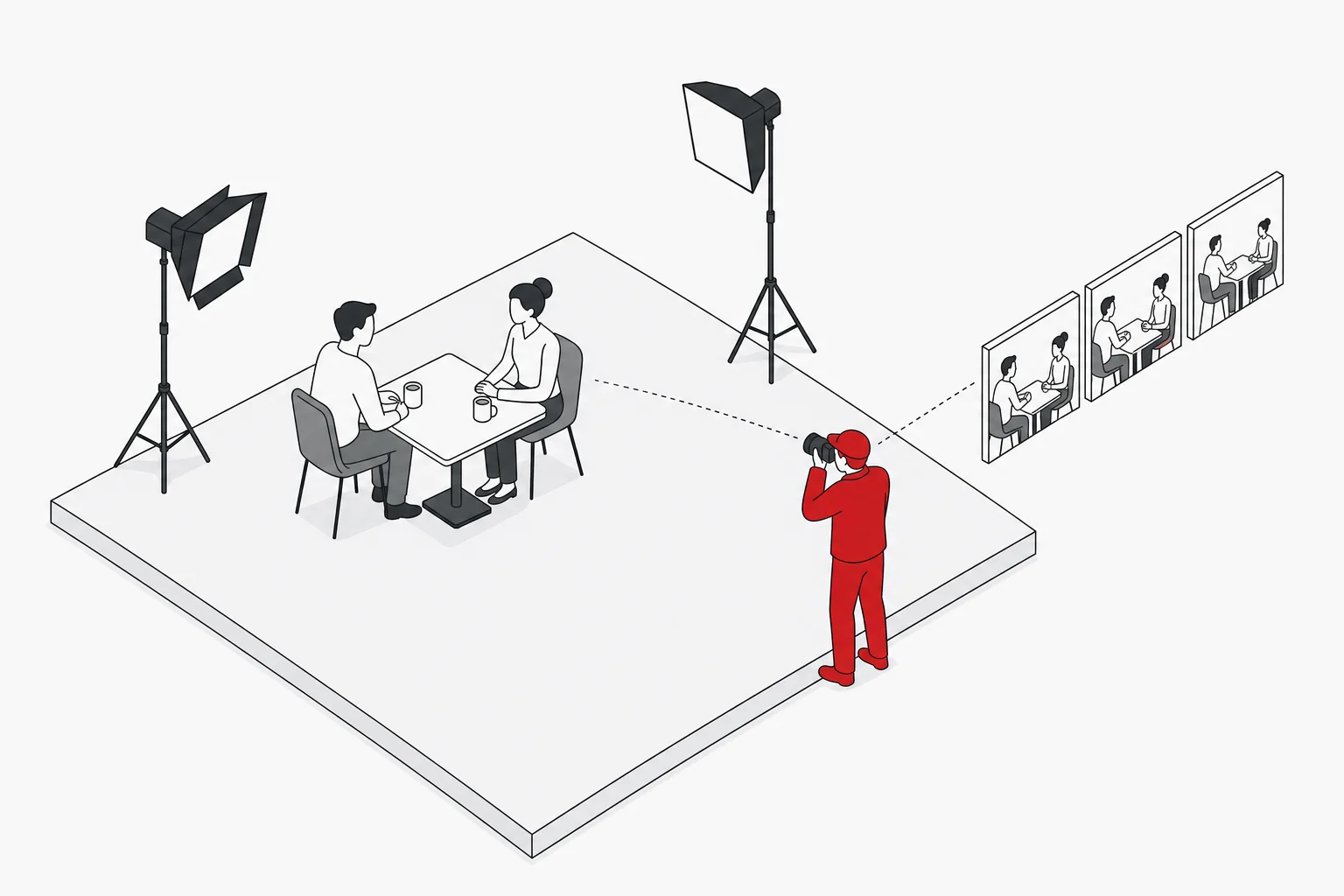
Unit stills photography is the on-set still photography that documents a film or television production for promotion. These are single frames intended for posters, press kits, streaming artwork, lobby displays and social media: the images audiences see long before, and often instead of, the title itself.
Because these frames carry the public face of the production, they sit at the start of a longer chain: capture, then talent approval, then delivery to publicists and distributors. Getting the shoot right makes everything downstream easier. This guide covers how to plan and run that shoot; its companion, delivering approved stills, covers the hand-off.
The photographer’s role on set
The unit stills photographer is embedded with the crew and works closely with the camera department, framing similar compositions to the cinematographer but capturing them as stills. The job is partly invisibility: shooting through takes without disturbing the actors, the sound department or the first AD’s schedule. Silent or blimped camera bodies make this possible.
It is also a job of judgement. A strong unit photographer reads the scene, anticipates the beats worth catching, and knows which moments will translate into a publicity still rather than just a record of the day. They liaise with the publicist about what marketing needs, and stay alert to continuity, lighting and which cast members are in frame.
What the photographer captures on set
Three kinds of image come off a unit. The first, and the bulk of the coverage, is frames captured as the scene plays out: the photographer works around the rolling camera, catching the performance as it happens. These have energy and truth, but they are dictated by whatever the take gives.
The second is behind-the-scenes moments: the director working with the cast, the crew at work, the rig and the craft of the day. This material rarely carries a poster, but it is exactly what feeds press features, social channels and the making-of story, so it is worth briefing the photographer to look for it rather than treating it as an afterthought.
The third is the set-up shot. Where a key image simply cannot be made during a take, because the camera is in the wrong place for it or the beat passes too fast, a photographer will sometimes ask for a brief re-run of a very small section of the take, purely so they can get the frame. This is usually slotted into a natural pause, such as while the director reviews playback or immediately after a take is called, and it is negotiated on the day between the photographer and the first AD. It costs the schedule very little when it is anticipated, and it is often the difference between having the shot and not having it. A producer who knows this is coming can make room for it rather than fighting it.
Gallery shoots are a separate thing
The images above all come off the unit, during production. A gallery shoot, also called a specials or key art shoot, is something else entirely: a dedicated photo session, typically with a lit studio or backdrop set up away from the action, where cast are brought in individually or in groups for composed portraits. It is scheduled and budgeted in its own right rather than squeezed between takes, and it produces the polished, controlled frames that posters and streaming artwork are usually built from.
The distinction matters because the two are often confused. Nothing that happens on set, between takes, is a “specials” shoot. Both sets of images, though, end up in the same place: gallery images contain the cast’s likeness just as unit stills do, so they go through the same talent approval process and count towards each actor’s allowance.
Managing volume and files
A stills photographer can generate thousands of frames across a shoot, and volume is its own problem. In our experience the best photographers submit somewhere between 200 and 500 curated images per shooting day, enough to cover the day properly without burying the people who have to review it. But quantity of coverage is not the only thing that matters; what matters just as much is how those files are organised from the moment they are shot.
Agree a clear, consistent delivery spec before the first day, and there is more in it than people expect. It should cover:
- A file-naming scheme, covering production code, date, scene or setup, and a sequence number, so frames stay traceable across cards, drives and editors. Our note on file naming conventions sets out a sensible pattern.
- A folder structure that separates each shooting day, and keeps unit photography, gallery and any screen grabs apart rather than merged into one undifferentiated dump.
- The file formats you expect, and where each is used: RAW originals archived for full grading latitude, and rendered JPGs for review and publicity. RAW vs JPG for production stills covers which belongs where.
- How photographer edits travel. This is the one that catches productions out. A RAW file is never altered directly: the photographer’s exposure, colour and crop adjustments live outside it, in an XMP sidecar alongside the file or in a Capture One catalogue or settings folder. Separate those from their RAWs, by renaming, moving or copying files without them, and the edits are silently lost, so cast and client end up reviewing flat, ungraded frames that look nothing like the photographer’s intent. The same applies to embedded metadata: captions, credits and rights information get stripped by careless handling. Both need to be carried deliberately, not assumed.
Then run it properly day to day: back up to two locations, log each card as it lands, and resist the urge to leave culling until the end of the shoot, because little-and-often keeps the eventual edit manageable. None of this is glamorous, and all of it is the difference between a set that flows into approvals and one that has to be rebuilt before it can even be reviewed.
Take the admin off the photographer
All of that is real work, and it lands on someone who has already had a very long day. A unit photographer’s day on set is punishing, and every hour spent renaming files, wrangling sidecars and preparing deliveries is an hour not spent thinking about the next day’s coverage, or simply resting before it.
We would rather they spent that time getting the images that make the impact. So where a production takes up our photo lab service, Image Approvals takes as much of this admin off the photographer as we can: they hand over each day’s cards at the end of the shooting day, and the lab picks it up from there: RAW conversion, edit and sidecar preservation, renaming, captioning, metadata and quality control, through to a distributor-ready delivery.
It works best when it is set up at the start of the shoot rather than retrofitted at the end, because the hand-over becomes a routine the photographer barely notices instead of a scramble once the volume has piled up. If you have a production coming up, talk to us before day one and we will get that flow running from the first card.
From shoot to approvals
The shoot only earns its keep once the right images reach the people who sign them off. From the full take, the photographer and production cut down to a working selection, which is then put through cast review: actors exercise their approval rights, and rejected frames drop out. The survivors form the approved set, and once cast and stakeholders have signed off, the unit publicist or a producer typically works through it to pick the key selects: the hero frames the campaign will actually be built from.
This is where a structured workflow pays off. Tying capture, approval and delivery together means only signed-off images ever leave the production, with a record of who approved what. To see the approval stage in full, read how talent image approvals work; to see how approved frames are packaged and sent, continue to delivering approved stills. If you would like to see the process end to end, book a demo.