
Photography delivery · Guide

File naming conventions for film & TV unit stills

A consistent file naming convention is the cheapest insurance on a shoot. It keeps stills sortable, traceable and ready for approvals long after the unit has wrapped. This guide gives you a convention you can adopt today.

Why a naming convention matters for stills

On a film or TV production, the same set of unit stills passes through a lot of hands: the photographer, the picture desk, talent and their representatives for approval, the studio archive, and eventually publicity, EPK and press. Each of those steps is easier, and safer, when a file's name tells you exactly what it is.

When filenames are inconsistent, the costs are quiet but real: images get duplicated because nobody can tell two near-identical files apart, approvals stall because the right frame can't be found, and the wrong version slips into a campaign because final_v2_REALfinal.jpg means nothing to the next person. A convention removes that ambiguity before it becomes an expensive mistake.

The goal is simple: anyone should be able to identify an image from its name alone, and files should sort into a sensible order automatically. Everything below serves those two aims.

Order the file from fixed to variable

The most reliable filenames read left to right from the parts that never change on a given production to the parts that change with every frame.

Lead with the production code, then the season & episode, then the shoot day. Follow with the frame number, and (only if you actually need one) an optional version marker as the last part of the name. The file-type extension comes after that, but you won't type it: your software appends it when the file is saved. Because the stable parts come first, an alphabetical sort becomes a meaningful, chronological one: files group themselves by production, then day, then frame, with no extra effort.
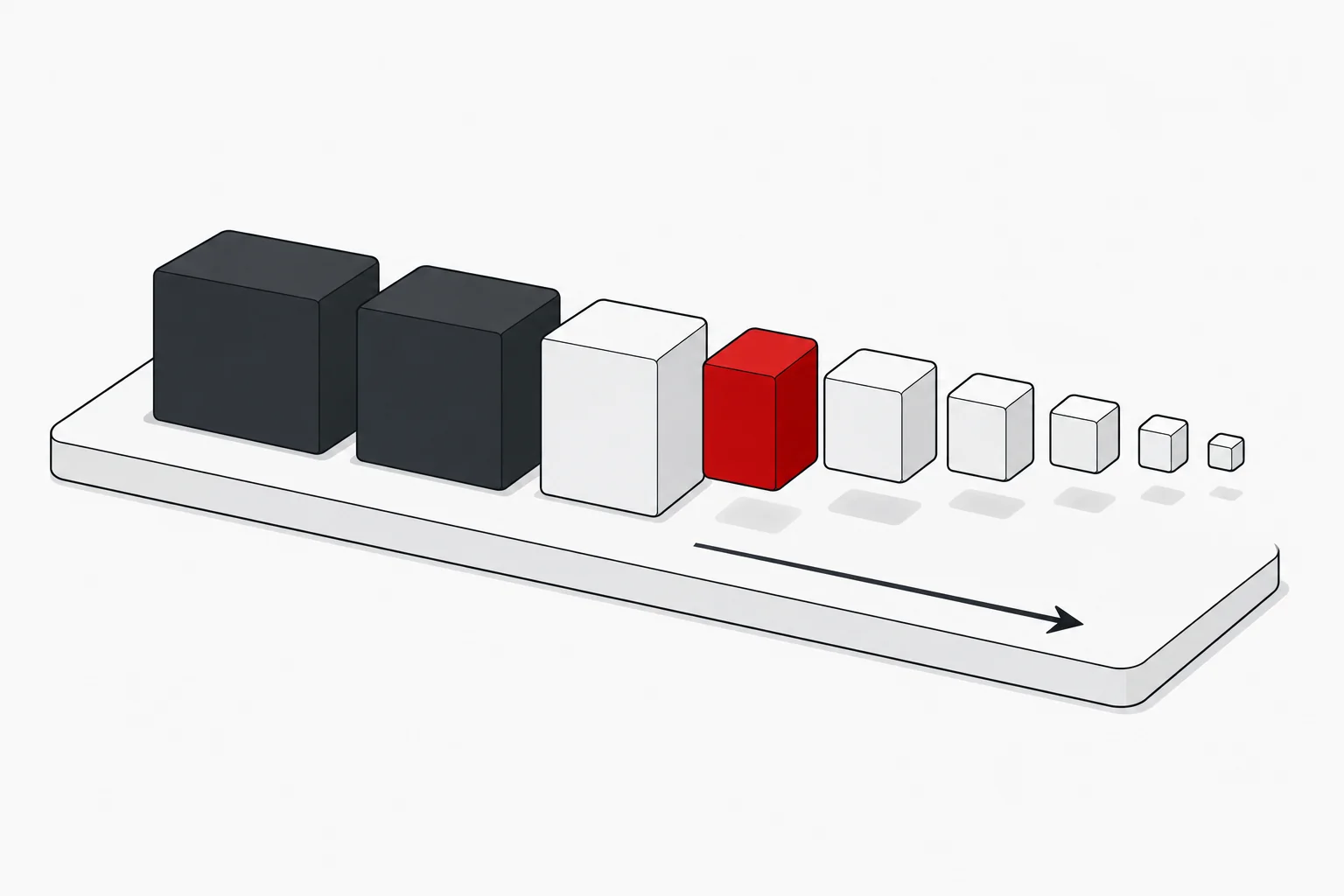
An isometric illustration of filename segments as stacked blocks, ordered left to right from large anchored fixed parts to smaller lighter variable parts

The anatomy of a delivery filename

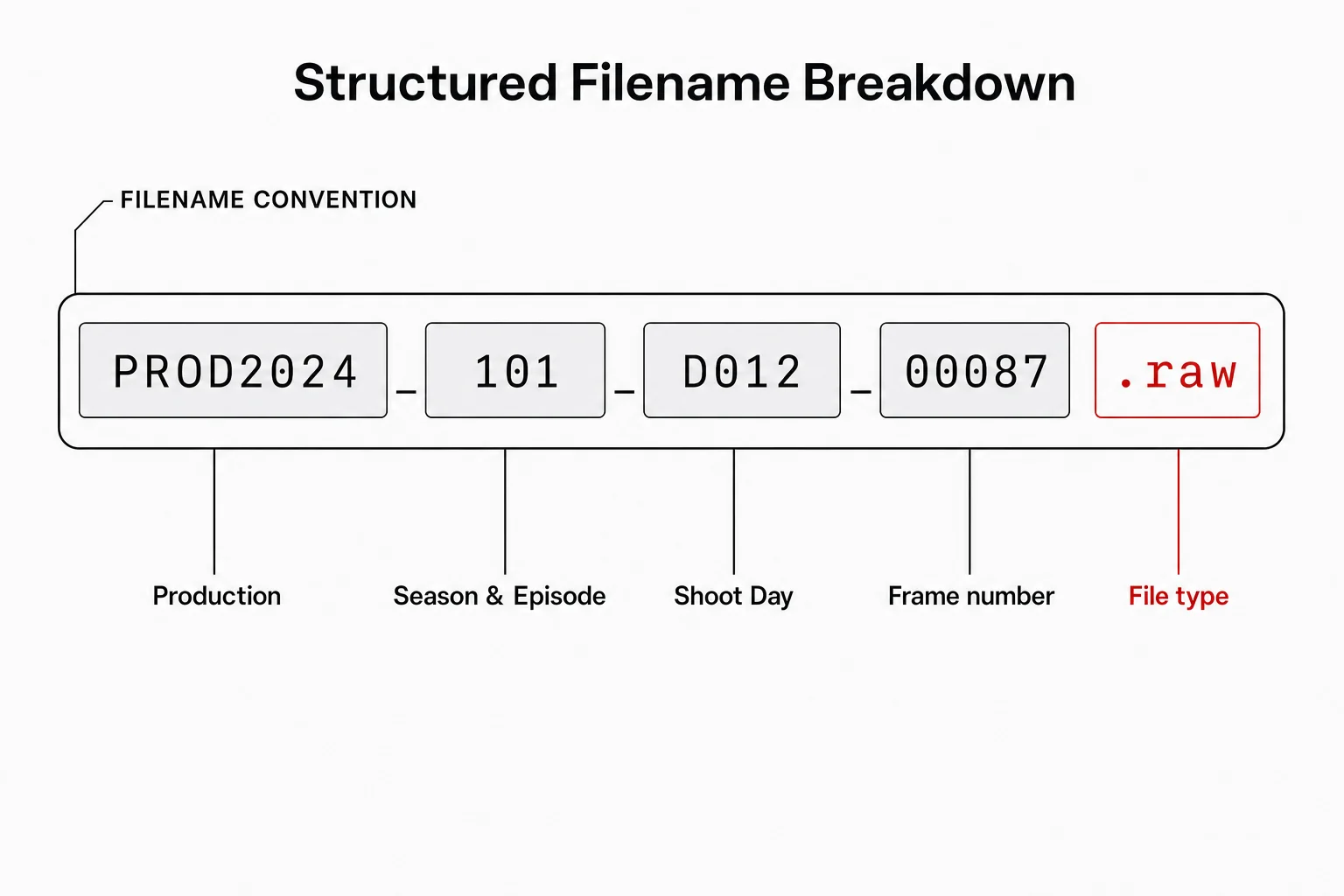
Each segment is separated by an underscore, with the file-type extension added last after a single period, so it stays human-readable and easy to split back into fields by software. A typical unit-stills filename looks like this:

Diagram breaking the filename PROD2024_101_D012_00087.raw into colour-coded segments labelled Production, Season and Episode, Shoot Day, Frame number and File type
A structured filename split into production, season and episode, shoot day, frame number and file type. The 101 segment is season 1, episode 1, not episode 101.

What each segment means

Pick the segments your production actually needs. A single-camera commercial may drop the episode field; a long-running series will want all of them.

Production A short fixed code for the show, e.g. PROD2024 or an agreed abbreviation. Keeps a slate of productions from colliding in one archive.
Season & episode A single number carrying both: the first digit is the season, the last two are the episode. So season 1 episode 1 is 101 (not episode 101), and season 3 episode 4 is 304. Omit it entirely for a feature or one-off.
Shoot day D012: the production shoot day, zero-padded. Sorts the whole delivery in the order it was shot.
Frame number 00087: a zero-padded running number unique within that day, so no two files clash.
File type The extension added last after a single period, e.g. .raw, .arw or .jpeg. It tells every system what the file actually is.
Version marker (optional) Optional, and it goes before the file type, as the last part of the name itself, e.g. PROD2024_101_D012_00087_SEL.raw. Use SEL (select) or v2 only when you genuinely need to distinguish states, keeping it short and from an agreed list.

The rules that keep filenames portable

These are the habits that stop a filename breaking the moment it crosses to another operating system, archive or approvals platform.

Safe characters only

Letters, numbers, hyphens and underscores. Avoid spaces, slashes, colons, ampersands, quotes and accented characters: they break URLs, command-line tools and some archives. Don't add any periods other than the single one at the end that marks the file format; extra dots inside the name can cause corruption and breakages.

Pad your numbers

Zero-pad sequence numbers (00001, not 1) and shoot days (D012 not D12) so files sort numerically. Without padding, 10 sorts before 2 and your delivery falls out of order. We recommend padding sequence numbers to five digits, as this will typically cover most quantities of images shot across a day or production, and padding shoot days to three digits (D001-D999) so they sort correctly even on long-running productions.

Keep it short

A filename should be human-readable at a glance, not a paragraph.

ISO dates

When you include a date, write it YYYY-MM-DD (2024-06-27). It sorts chronologically by default and is unambiguous across regions.

Consistent separators

Use underscores between fields and hyphens within a field. Pick one scheme and apply it to every file. Mixed separators defeat the point.

Lower friction, lower case

Decide on case once and stick to it. Some systems treat IMG_01 and img_01 as the same file; consistency avoids silent overwrites.

Key terms

Zero-padding
Adding leading zeros to a number (0007) so filenames sort in true numerical order rather than as text.
ISO 8601 date
The YYYY-MM-DD date format, which sorts chronologically and is unambiguous internationally.
Shoot day
The production shoot day as numbered on the call sheet, not your own day count. If it is your second day on set but the production's fourth day of filming, the shoot day is 004. It is the most useful single field for sorting a whole delivery in order.
Select
A frame chosen from the wider take as a candidate for delivery or approval, often marked SEL in the filename or in metadata.
Sidecar
A companion file that travels next to the image and holds its metadata and edits: an .xmp sidecar, or a Capture One settings file such as .cop or .cos. Same name, different extension: send it with the image or that work does not travel with it.
Metadata
Information about the image (caption, copyright, keywords, edit settings) stored inside the file or in its sidecar rather than in the filename, the right place for anything that changes.
Delivery spec
The agreed set of formats, sizes, colour space and naming rules a production expects on handover.

Pair this with the full delivery specs

Naming is one part of a clean handover. The Photography Delivery Specs cover formats, colour space, resolution and metadata too.

Frequently asked questions

Why not just use the camera's original filenames? +
Camera filenames (like DSC_0042) repeat across cards and cameras, carry no production context, and reset to zero, so two different frames can end up with the same name. A convention adds the context that makes every file unique and traceable.
Should the filename include the talent's name? +
Generally no. Talent appear across many scenes and days, names can be sensitive before a project is announced, and casting can change. Keep who-is-in-frame in metadata and in your approvals system, and keep the filename about where and when the frame was shot.
Spaces, hyphens or underscores between words? +
Avoid spaces. They break URLs, scripts and some archives. A common, dependable scheme is underscores between the major fields (production, day, frame) and hyphens within a field. The key is to pick one and apply it consistently.
How many digits should I pad sequence numbers to? +
We recommend five digits (00001-99999). That typically covers most quantities of images shot across a day or production, and keeps everything sorting in the right numerical order even on the busiest shoot days.
When should the convention be agreed? +
Before the first shoot day. Agreeing it up front means files are named correctly at ingest and never need a risky bulk rename after they have been delivered, approved or archived.

Deliver approved stills without the spreadsheets.

Image Approvals keeps your unit photography organised, traceable and ready for talent approval, from ingest to final delivery. Tell us about your production.

Request a demo

Loading the form…

Loading the form…

Loading the form…