
Production stills guide

Everything you need to know about XMP files

If you've ever received unit stills from a photographer and noticed mysterious .xmp files sitting alongside the images, you're not alone. These small files preserve your photographer's creative work, yet they're often misunderstood, accidentally deleted, or mismanaged, leaving images that look nothing like what was delivered.

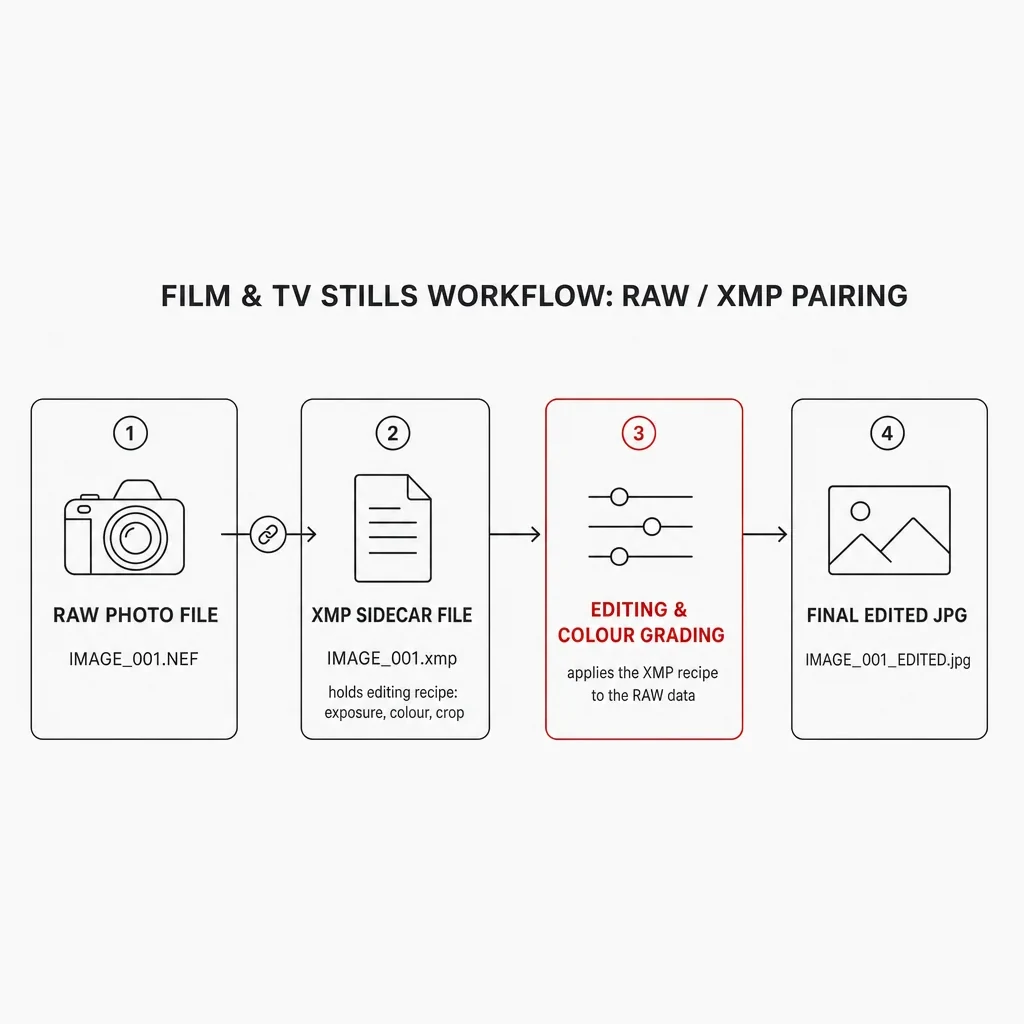
Diagram of a RAW photo file paired with its XMP sidecar file of edit instructions, rendering to a final edited JPG

In short

What is an XMP file?

An XMP (Extensible Metadata Platform) file is a small plain-text sidecar file that stores the editing instructions for a RAW image (exposure, colour, cropping, sharpening and more) without altering the original. Keep it alongside its RAW file or the photographer's edits are lost.

See how we handle XMP for productions →

What are XMP files?

XMP (Extensible Metadata Platform) files are small text files that store editing information for your images. Think of them as a recipe card that tells photo-editing software exactly how to display an image — exposure adjustments, colour corrections, cropping, sharpening, and hundreds of other potential edits.

They're known as ‘sidecar files’ because they sit alongside your RAW image files, holding all the editing instructions without modifying the original image itself. This non-destructive approach is one of the cornerstones of professional photography workflows.

XMP files are plain text and can even be opened in a text editor (though we don't recommend editing them by hand). They use XML formatting to store metadata and editing parameters in a way photo-editing software can read and interpret.

Diagram showing a RAW photo file plus an XMP sidecar of edit instructions producing a final edited JPG

What's inside an XMP file?

An XMP file is structured XML metadata. Rather than pixels, it holds the parameters that tell editing software how to render the RAW image. Typical contents include:

Develop settings Exposure, contrast, highlights, shadows, whites and blacks — the core tonal adjustments.
Colour & white balance Temperature, tint, vibrance, saturation and per-channel HSL corrections to match the film's look.
Crop & geometry Crop boundaries, straightening, lens corrections and perspective adjustments.
Detail Sharpening and noise-reduction parameters applied to the image.
Metadata Captions, keywords, copyright, ratings and other descriptive fields about the image.
Software identifiers Which application wrote the file (e.g. Lightroom or Camera Raw) and its processing version.

Why XMP files matter in unit photography

When a unit stills photographer delivers their work, they've spent considerable time editing each image to look its best. Those edits live in the XMP files (or embedded metadata). Without them, you lose all of that creative work.

Professional quality control

Your photographer has colour-corrected images to match the film's look, adjusted exposure for consistency and fine-tuned each shot. XMP files preserve that work so images look professional when shown to talent and distributors.

Consistency across devices

Without XMP files, the same RAW image looks completely different depending on which software opens it. XMP files ensure everyone sees the images exactly as the photographer intended.

Talent approval accuracy

Talent need to review professionally edited versions, not raw, unprocessed files that may look flat or underexposed. Lose the XMP files and talent see inferior versions and may kill otherwise great shots.

How XMP files work

The file relationship
When a photographer edits a RAW file in Adobe Lightroom or Camera Raw, the software creates an XMP sidecar with the same filename as the image — for example IMAGE_001.NEF pairs with IMAGE_001.xmp. The RAW file and its XMP must stay together: if you move, rename or organise files, both must be kept in sync or the editing information is lost.
Sidecar XMP files
Proprietary RAW formats (NEF, CR2, ARW, RAF, etc.) cannot have editing data embedded, so they always use a separate .xmp sidecar. These files must be managed alongside — and kept with — their corresponding images.
Embedded XMP data
DNG, JPEG, TIFF and PSD files can have XMP data embedded directly inside them, so no separate sidecar is needed. However, some software still creates a sidecar file even for these formats.

Common problems with XMP files

Based on working with over 120 film and TV productions, we see the same XMP-related problems occur repeatedly. These are the most common.

XMP files get separated from images

This happens when files are organised into folders (by actor, scene or approval status) but the XMP files aren't moved with the RAW files. The result: RAW files that look completely different from what the photographer delivered.

File renaming breaks the connection

Rename IMAGE_001.NEF to ActorName_Scene5.NEF but not IMAGE_001.xmp, and the software can't find the editing instructions anymore. Rename inside Adobe Lightroom or Bridge so any XMPs are renamed in line with your RAW files automatically.

XMP files look like ‘junk’ and get deleted

To someone unfamiliar with photography workflows, .xmp files look like random technical files that can be deleted to ‘clean up’ the folder. This is disastrous, and usually isn't discovered until it's too late to recover them.

Best practices for managing XMP files

If you're managing unit photography yourself, these professional best practices help you avoid losing editing information.

  1. 1

    Never separate RAW and XMP files

    When moving, copying or organising RAW files, always ensure their .xmp files move with them and stay in the same folder. Use software designed for photo management rather than manual file operations.

  2. 2

    Rename files in pairs

    If you must rename files, use batch-renaming tools that rename both the RAW file and its XMP sidecar simultaneously, maintaining the connection between them.

  3. 3

    Back up everything

    Always back up both RAW files AND their XMP files together. A backup of just the RAW files is essentially useless if you lose the editing data.

  4. 4

    Don't filter out XMP files

    When transferring via cloud storage, WeTransfer or other methods, make sure .xmp files aren't filtered out or blocked. Some systems only transfer common file types by default.

  5. 5

    Verify after file operations

    After copying, moving or transferring, open a few random images in Lightroom or Camera Raw to confirm the edits are still applied. If images suddenly look ‘raw’ and unedited, the XMP files were lost.

  6. 6

    Educate your team

    Make sure everyone handling the files understands what XMP files are and why they're essential. One well-meaning team member ‘cleaning up’ a folder can destroy thousands of pounds of editing work.

XMP files vs. Capture One settings

Adobe (XMP) Capture One
Editing store .xmp sidecar file alongside the RAW image .cos settings files, plus catalog or session databases
Sidecar location Same folder as the RAW, matching filename Inside a CaptureOne settings subfolder beside the RAW
Needs the database? No: the .xmp holds the edits No: .cos files preserve edits independently of catalogs or sessions
Portable bundle Keep RAW + .xmp together .EIP packages bundle the image and .cos settings like a zip
Readable by Lightroom, Camera Raw, Bridge and many third-party apps Capture One (its own colour science and workflow)

Capture One stores editing settings differently: as individual .cos files, a catalog database (ideal for multiple projects), session databases (per-project workflows), or .EIP packages.

Overwhelmed by XMP files and technical file management?

This is exactly why Image Approvals includes comprehensive technical file handling as standard. We manage RAW files, XMP files, Capture One settings, file organisation and everything else, so you never have to worry about losing your photographer's work.

How Image Approvals handles XMP files

Technical file management is included as standard in every talent approvals package. Here's how we handle XMP files, and all other technical aspects of unit photography, for you.

Professional ingest & audit

We verify that all RAW files have their corresponding XMP or settings files on receipt, and check for file corruption, missing files and compatibility issues before any other work begins.

Synchronised file operations

When we rename, organise or tag files, our systems automatically keep RAW files and their XMP files in perfect sync. We never separate them.

Editing preservation

We maintain the integrity of your photographer's edits throughout the entire talent approval process, so all editing data is preserved and documented through to final delivery.

Cross-reference systems

We maintain cross-references between RAW files, XMP files, JPG previews and renamed versions, so if you need to pull out approved RAW files later, we can match them instantly.

Format conversion

Where needed, we convert files between formats (RAW to DNG, RAW to JPG and more) while preserving editing data and maintaining full traceability.

Complete documentation

We provide detailed reports showing the relationship between all file formats and versions, giving you complete transparency and traceability for your deliverables.

Frequently asked questions

What is an XMP file? +
An XMP (Extensible Metadata Platform) file is a small plain-text sidecar file that stores the editing instructions for a RAW image: exposure, colour corrections, cropping, sharpening and more. It uses XML formatting and sits alongside the RAW file without modifying the original, so the editing process stays non-destructive.
Why do my images look flat or wrong after moving the files? +
Almost certainly because the XMP files were left behind, deleted or filtered out during the move. The RAW file is showing its unprocessed data instead of the photographer's edits. Restore the matching .xmp files to the same folder, or re-request them from your photographer, and the edits will reappear in Lightroom or Camera Raw.
Can I delete XMP files to tidy up my folders? +
No. To someone unfamiliar with photography workflows .xmp files look like junk, but deleting them permanently destroys the photographer's editing work. Never delete them, and educate anyone handling the files so they don't either.
Do all image files need a separate XMP sidecar? +
No. Proprietary RAW formats (NEF, CR2, ARW, RAF) can't embed edits, so they always use a separate .xmp sidecar. DNG, JPEG, TIFF and PSD can embed XMP data directly inside the file, so they don't always need a sidecar, though some software still creates one.
How do I rename files without breaking the XMP link? +
Use Adobe Lightroom or Bridge for renaming. They automatically rename the .xmp sidecar in line with the RAW file, keeping the link intact. Manually renaming only the RAW file breaks the connection, so the software can no longer find the editing instructions.
What does Capture One use instead of XMP? +
Capture One stores edits in .cos settings files inside a CaptureOne settings subfolder beside the RAW images, and optionally in catalog or session databases. You only need the .cos files to preserve the edits, so ask your photographer to include the CaptureOne settings subfolder in the delivery.

Ready to stop worrying about technical file management?

Let our expert team handle all the technical aspects of your unit photography (XMP files, Capture One settings, conversions and delivery) so you can focus on your production. Technical file handling is included as standard.

Get a quote

Loading the form…

Loading the form…

Loading the form…